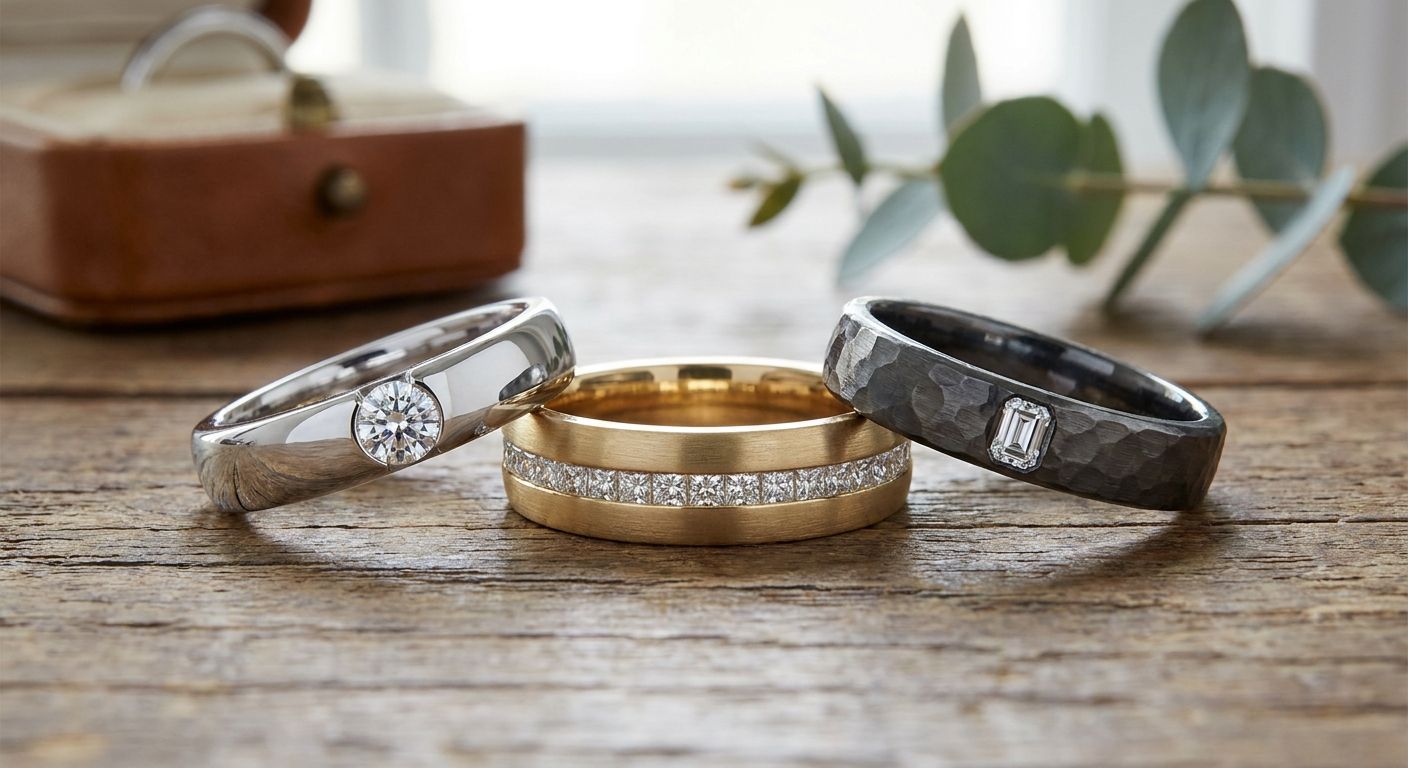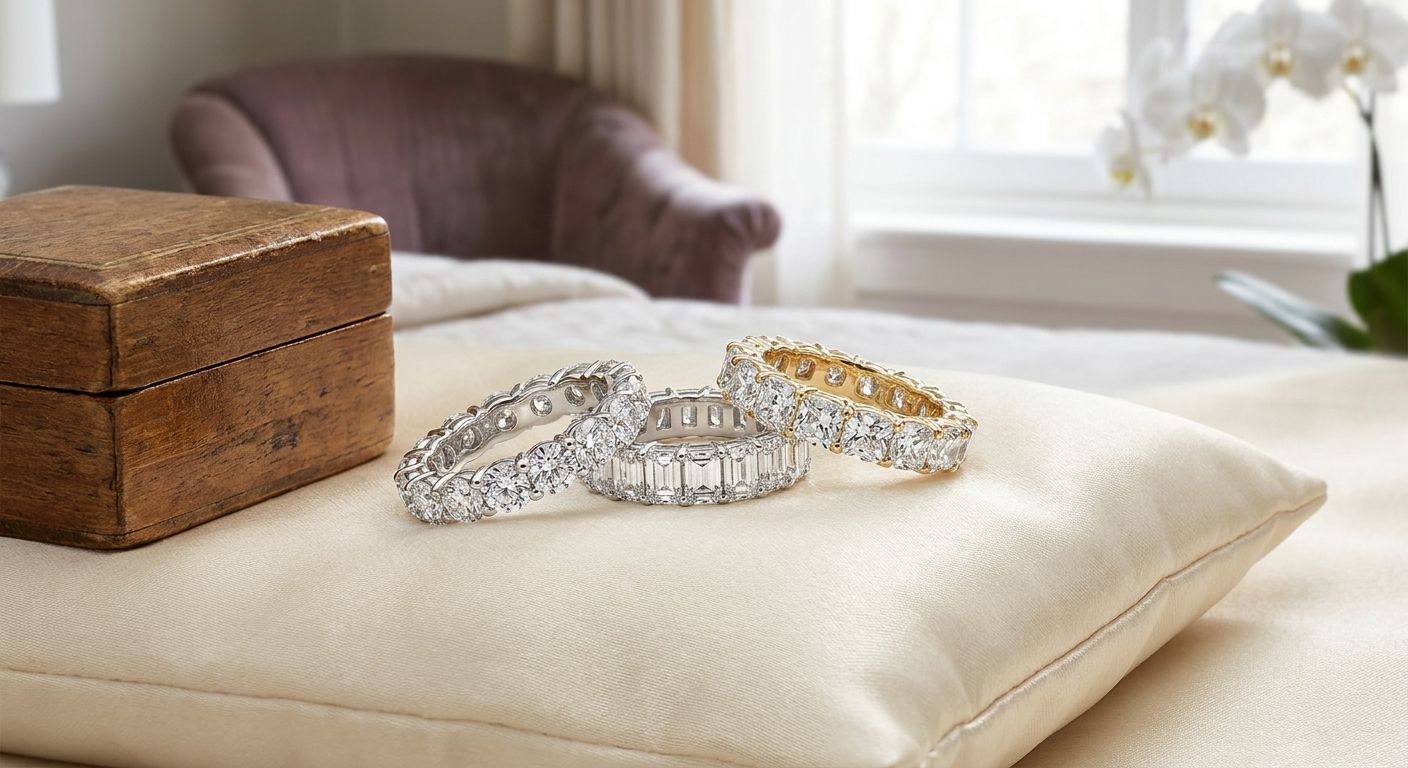
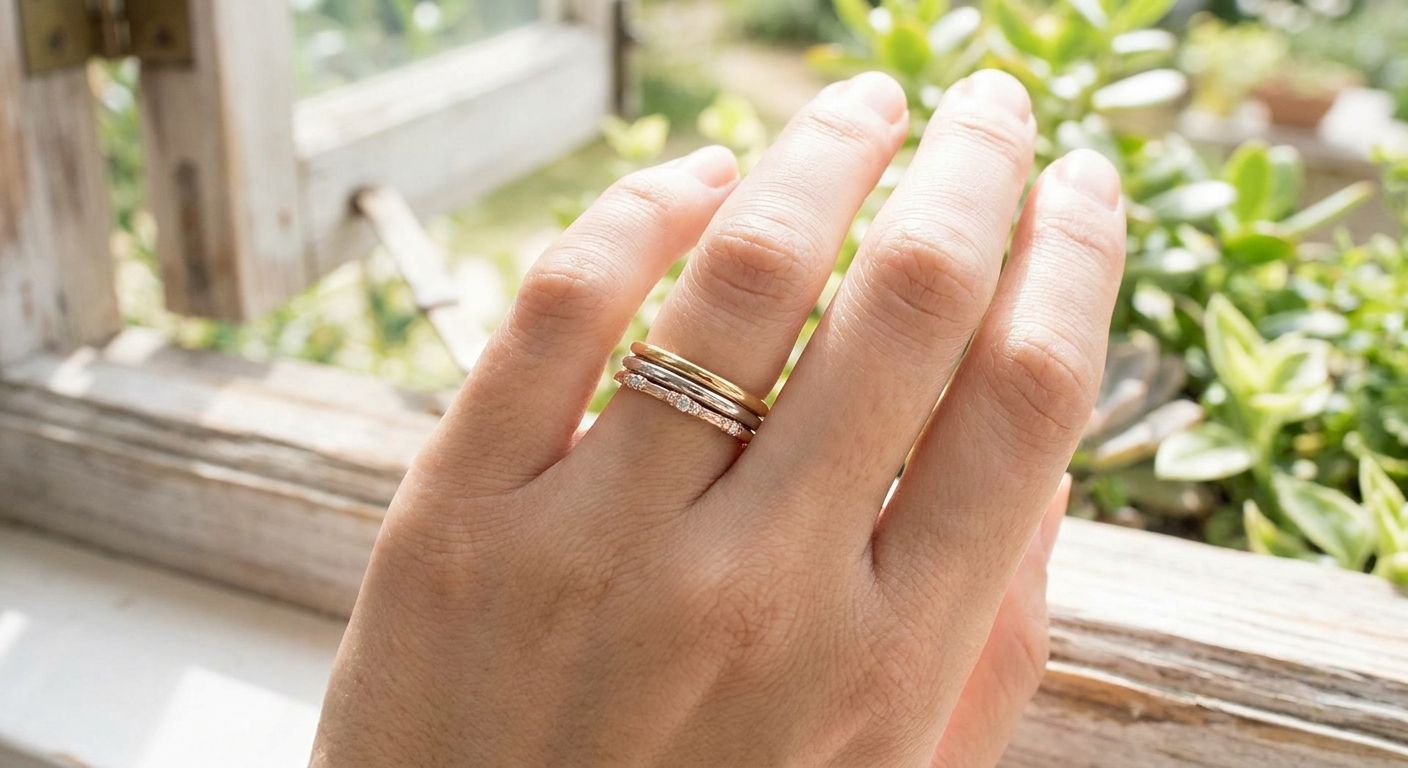
Stackable wedding bands for women in 2026 let you build a personalized ring stack over time instead of locking into one design forever. Best overall stackable wedding band for women in 2026: the curved contour band, shaped to sit flush against a solitaire engagement ring without gapping. Best for adding texture without overspending: the alternating diamond-and-gold station band. Best for anniversary stacking: the toi et moi two-stone band, which works better as a later addition than a first purchase.
- Curved contour bands are the best stackable wedding bands for women pairing with a solitaire engagement ring in 2026.
- Pavé eternity bands set with IGI or GIA certified lab-grown diamonds make the strongest foundation layer for a stack.
- Milgrain and alternating station bands add texture — stack them second or third, never first.
- Toi et moi stacking bands work best as an anniversary add-on, not an everyday starter band.
Why this matters
A ring stack isn't one purchase, it's several, spread across years — an engagement ring, a wedding band, then an anniversary add-on. Buying the wrong first band means every band added after it fights for space instead of sitting flat.
The stacking trend also changes how brides think about budget in 2026. Instead of one large statement ring, lab-grown diamond engagement rings paired with a thinner stacking band spread the same carat weight across two or three pieces, which changes how the hand reads without changing the total stone count.
What makes the best stackable wedding band for women
- Profile fit — the inside edge of the band needs to match the curve of whatever ring it sits against, or it rocks and gaps.
- Metal match — 14K or 18K gold tone should match your engagement ring's metal, or be intentionally mixed.
- Certification — lab-grown diamonds should carry IGI or GIA paperwork, same as the center stone.
- Band width — most stacking bands run 1.5mm to 3mm wide; wider bands dominate a stack, thinner ones disappear into it.
- Setting durability — pavé and channel settings wear differently over years of daily stacking friction.
- Stacking order — some bands are built to go first, others are built to layer on top.
Stackable wedding bands for women in 2026: at a glance
| Band style | Best for | Standout feature | Key limitation |
|---|---|---|---|
| Curved contour band | Pairing against a solitaire | Follows the exact curve of a round or oval center stone | Only fits specific ring silhouettes |
| Pavé eternity band | Everyday foundation layer | Continuous diamond coverage, no visible metal gaps | Pavé prongs need periodic inspection |
| Milgrain vintage band | Vintage texture in the stack | Beaded edge detail catches light differently than plain metal | Reads busy against an already-detailed engagement ring |
| Alternating station band | Adding movement without more carat weight | Diamond-and-gold rhythm breaks up an all-diamond stack | Less sparkle per inch than eternity styles |
| Toi et moi stacking band | Anniversary or symbolic add-on | Two-stone design reads as a deliberate later addition | Not designed to be a first or only band |
1. Curved contour band: best stackable wedding band for pairing with a solitaire
A contour band is cut with a notch or curve along one edge so it hugs the base of a solitaire or three-stone setting instead of sitting as a straight line against it. It's the band most brides add first because it's built specifically to solve the gapping problem that comes with rounded center stones.
Curved contour band pros:
- Sits flush against round, oval, and cushion solitaires
- Reads as one continuous line with the engagement ring
- Available with IGI or GIA certified lab-grown diamonds for consistent grading
- Thin profile (typically 1.5mm-2mm) leaves room to add more bands later
Curved contour band cons:
- The curve is cut for one specific ring shape and won't fit a different setting later
- Less standalone presence if worn without the engagement ring
Best for: the first band added to a solitaire or three-stone engagement ring. Verdict: Buy.
2. Pavé eternity band: best stackable wedding band for a diamond foundation layer
A pavé eternity band sets small diamonds edge to edge around the full circumference of the ring, with no visible metal breaks. It functions as the base layer of a stack — the band the others get compared against for sparkle and coverage.
Pavé eternity band pros:
- Continuous coverage means no bare metal gaps when viewed from any angle
- Works as a wedding band on its own, before any stacking begins
- Certified lab-grown diamond options keep cost per carat lower than mined stones of the same grade
Pavé eternity band cons:
- Pavé prongs sit lower and can catch on fabric more than a plain band
- Resizing a full pavé band is harder and more expensive than resizing a plain shank
Best for: brides who want one band that works alone in 2026 and as a stack base later. Verdict: Buy.
3. Milgrain vintage band: best stackable wedding band for texture
Milgrain adds a fine beaded edge along the border of the band, a detail borrowed from early 20th-century ring design. In a stack, it's the layer that breaks up an otherwise smooth, modern set of bands.
Milgrain band pros:
- Beaded edge catches light at angles a plain band doesn't
- Pairs well with vintage-inspired or halo engagement ring settings
- Available in narrow widths that don't compete with an eternity band underneath
Milgrain band cons:
- Detail can read as busy stacked against a band that already has heavy detailing
- Harder to keep clean in the grooves compared to a smooth band
Best for: a second or third layer added to a simpler foundation band. Verdict: Buy (as a second layer, not a starter band).
4. Alternating station band: best stackable wedding band for movement without more carat weight
This style alternates diamond stations with plain gold sections instead of covering the full band in stones. It adds visual rhythm to a stack without pushing total carat weight — and total cost — higher.
Alternating station band pros:
- Breaks up an all-diamond stack so it doesn't read as one solid sparkle block
- Lower diamond density than a pavé band for the same visual width
- Works in both a two-band and a three-band stack without overwhelming either
Alternating station band cons:
- Less overall sparkle per inch than a full eternity band
- The gold sections show scratching over time more visibly than a fully set band
Best for: filling out a stack after the foundation band and contour band are already in place. Verdict: Hold — a strong third piece, not an essential first or second purchase.
5. Toi et moi stacking band: best stackable wedding band for anniversary layering
Toi et moi means "you and me" and refers to a two-stone design, usually two diamonds set side by side rather than one center stone. As a stacking band, it reads as a deliberate, separate addition rather than part of the original bridal set.
Toi et moi band pros:
- Two-stone design carries symbolic weight for anniversaries or milestone years
- Distinct silhouette from round eternity or contour bands, so it doesn't compete for the same visual space
- Pairs well with toi et moi engagement rings for a matched-theme stack
Toi et moi band cons:
- Doesn't function well as a standalone wedding band — it's built to be an addition
- Asymmetric designs can shift position more than a symmetrical band
Best for: an anniversary or milestone add-on layered onto an existing stack. Verdict: Wait — buy this after the foundation and contour bands, not instead of them.
How we ranked these stacking bands
Each style above is scored against the six criteria listed earlier: profile fit, metal match, certification, band width, setting durability, and stacking order. The contour band and pavé eternity band rank highest because they solve the two most common stacking problems in 2026 — gapping against a solitaire and needing a band that works standalone before any stacking starts. The alternating and toi et moi styles rank lower on urgency, not on quality; they're built to be added later, so buying them first works against the logic of stacking itself.
Stack the trend beyond the ring
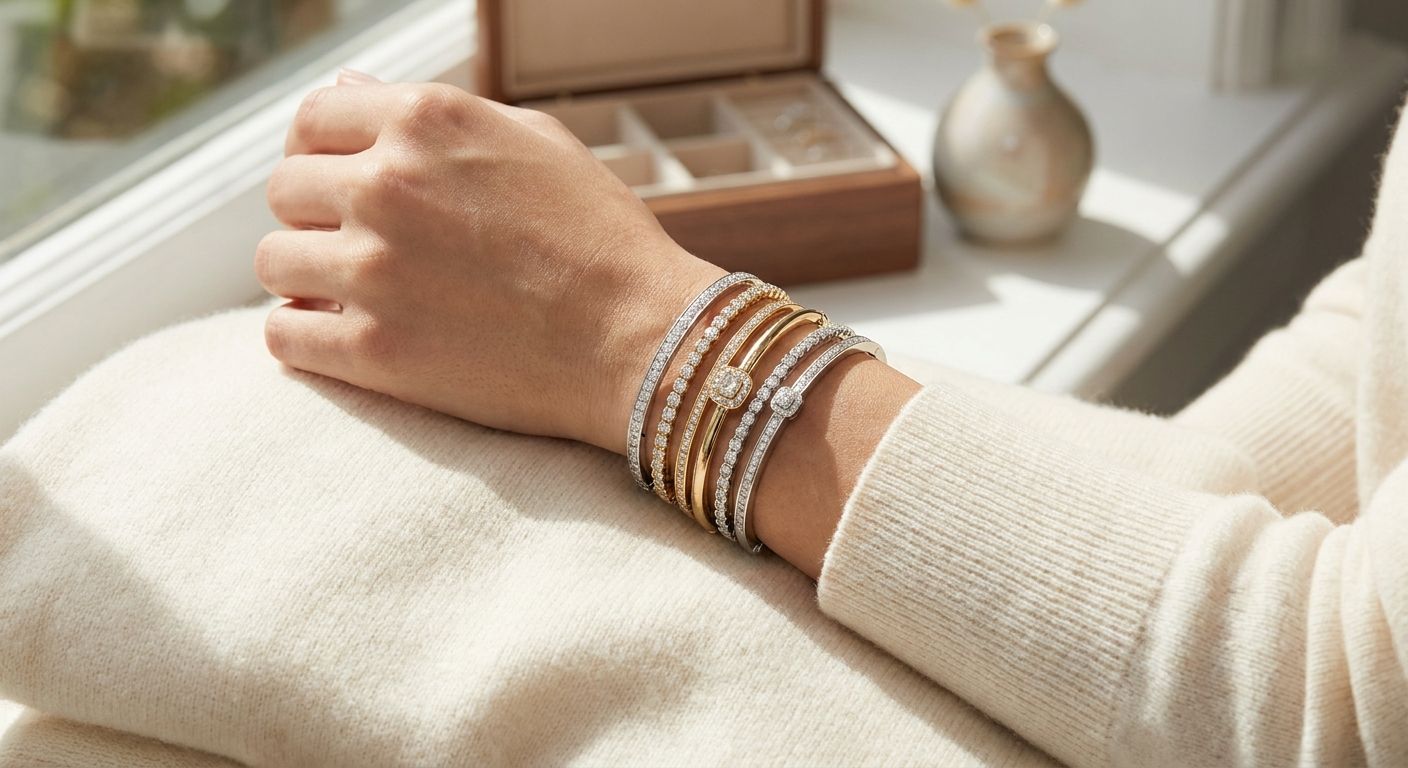
Stacking isn't limited to the ring finger. The same layering logic that applies to bands shows up in tennis bracelets to stack — multiple thin diamond lines worn together on the wrist instead of one wide piece. Brides building a ring stack in 2026 often mirror it with a bracelet stack for the same reason: it spreads the sparkle across more pieces instead of concentrating it in one.


Which stackable wedding band should you choose?
For most brides shopping in 2026, the answer is a curved contour band first, a pavé eternity band as the base, and everything else added later. Skipping straight to a milgrain or alternating band before the foundation is in place usually means re-buying the stack order within a year.
Stack the ring you'll wear every day first, then add the ones you love.
“Stack the ring you'll wear every day first, then add the ones you love.”
If budget is the deciding factor rather than sequence, the engagement ring cost guide breaks down 2026 pricing by carat and cut, which helps set what's left over for the stacking bands themselves.
FAQ
What are the best stackable wedding bands for women in 2026?
The curved contour band and pavé eternity band rank highest for 2026 because they solve fit and foundation problems first. Milgrain, alternating station, and toi et moi bands work best as second or third layers added after those two.
How many bands should I stack at once?
Most stacks start with one or two bands and grow over several years. Adding three or more bands at once usually means the profile fit hasn't been checked against each individual piece.
Do stacking bands need to match metal color?
Not strictly, but matching 14K or 18K gold tone across bands keeps the stack looking intentional rather than accidental. Mixed metal stacks work when the mixing is deliberate from the first two bands.
Can a stacking band be worn without an engagement ring?
Pavé eternity bands and alternating station bands work fine on their own. Curved contour bands are cut to match a specific center stone shape, so they look incomplete without it.
Are lab-grown diamonds in stacking bands certified?
Reputable stacking bands carry IGI or GIA certification on the diamonds, the same standard used for center stones. Certification confirms the diamond's grading independent of the retailer.
What width should a first stacking band be?
Most first stacking bands run 1.5mm to 2mm wide, thin enough to leave room for additional bands later. A wider first band can make later additions look crowded.
Is a toi et moi band a good first wedding band?
No — toi et moi bands are built as a symbolic add-on for anniversaries or milestones, not as a standalone first wedding band. They work best layered onto an existing stack.
Do stacking bands need resizing together?
Each band gets resized individually, and pavé or eternity bands cost more to resize than plain bands. Check resizing terms before buying multiple bands at once.
One last thing
The single mistake that undoes most ring stacks isn't the band style — it's buying the second and third bands before checking how they sit against the first one in person. A contour band cut for a round solitaire in 2026 will not sit flush against an oval or cushion cut bought later, so confirm shape compatibility before adding to the stack, not after.