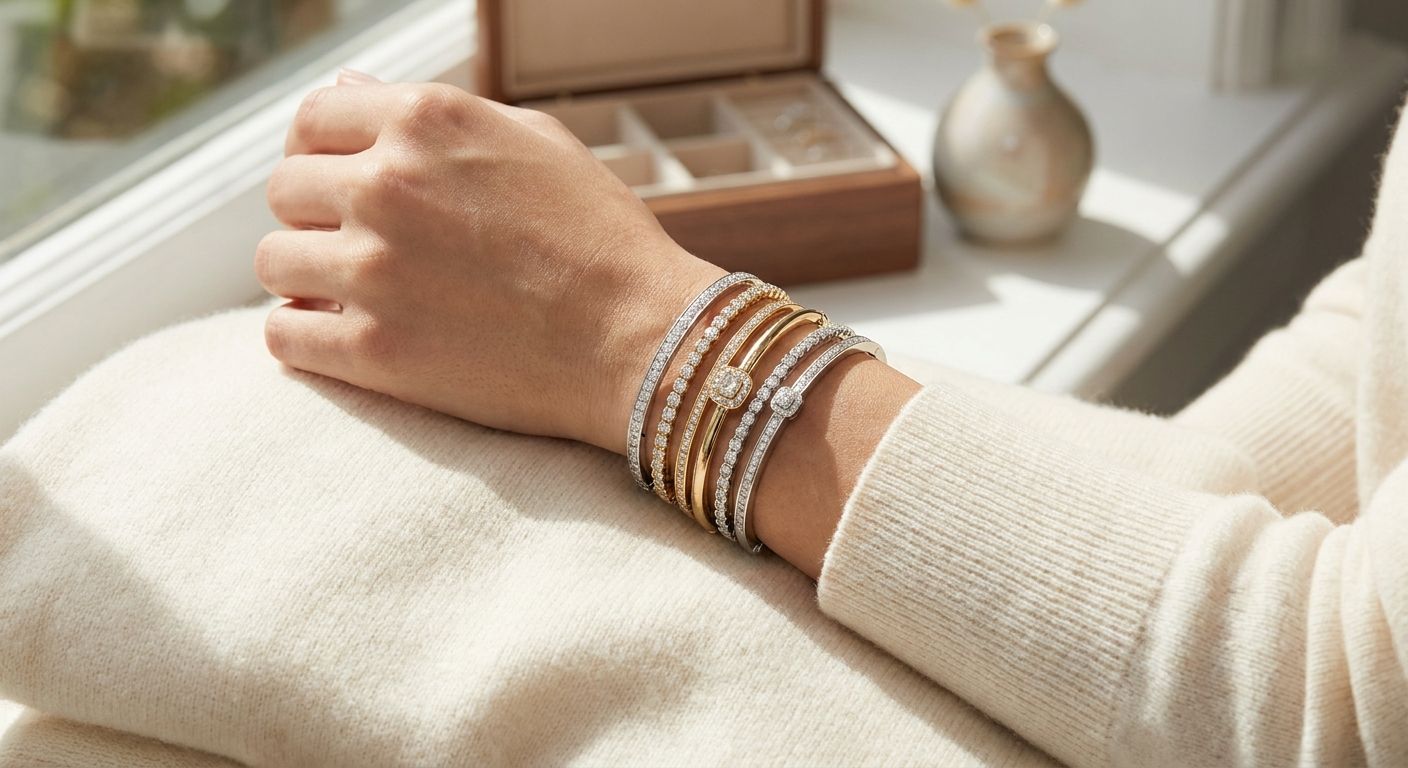
Diamond bangle bracelet stacking works when you plan the mix before you buy the third piece — not after your wrist looks cluttered. Best overall for a stack you'll wear daily: a solid diamond bangle. Best for effortless on-and-off wear: a hinged diamond bangle. Best diamond-forward centerpiece: a certified lab-grown diamond tennis bracelet. Best budget-friendly layering piece: a thin pavé diamond bangle.
- Solid diamond bangles anchor a stack and hold up to daily wear better than thin pavé pieces.
- Diamond bangle bracelet stacking works best with 3 to 5 pieces mixing widths, not 5 identical bangles.
- A certified lab-grown diamond tennis bracelet from Raul Diamonds adds a diamond-forward centerpiece without the bangle's rigid sizing.
- IGI or GIA certification matters more on the diamond piece in your stack than on the plain gold bangles around it.
Why this matters
Most people buying into diamond bangle bracelet stacking make one mistake: they buy five bangles that all compete for attention instead of one that carries the diamond weight and a few plain gold pieces that support it. A stack reads expensive when one piece is clearly the diamond piece and the rest are quiet. Get that ratio wrong and even a well-made bangle looks like clutter.
Certification matters here too. If a diamond bangle or diamond tennis bracelet is going to sit on your wrist every day in 2026, you want the stone graded by IGI or GIA, not a house-brand certificate nobody outside the store recognizes. That single detail protects resale value and insurance value long after the trend photos stop mattering.
What makes the best diamond bangle bracelet for stacking
- Profile width — thinner bangles (roughly 2mm) layer easily; wider bangles (4mm+) work better as a solo statement
- Opening mechanism — hinged or clasped bangles go on faster than solid, unbroken circles
- Certification on the diamonds — IGI or GIA paperwork on the stones, not just a stamped karat mark on the metal
- Metal match — 14K gold in one tone (yellow, white, or rose) across the stack reads intentional; mixed metals read accidental unless done on purpose
- Comfort against the next piece — bangles with prongs or raised settings catch on smooth bangles next to them
- Room to grow the stack — buy the anchor piece first, then add one bangle at a time instead of five at once
Diamond bangle bracelets at a glance
| Style | Best for | Standout feature | Key limitation |
|---|---|---|---|
| Solid diamond bangle | Everyday stacking | Rigid shape holds its position all day | Fixed size — no adjustability |
| Hinged diamond bangle | Easy on/off wear | Opens on a hinge, no wrestling over the hand | Hinge adds a slightly thicker profile |
| Diamond tennis bracelet | Diamond-forward centerpiece | Continuous diamond line, adjustable clasp | Needs a jeweler for length changes |
| Diamond cuff bangle | Single statement piece | Open-back design fits a range of wrist sizes | Doesn't stack well with more than one other piece |
| Pavé diamond bangle | Budget-friendly layering | Thin profile, easy to stack 3-4 at once | Smaller stones catch less light individually |
1. Solid diamond bangle: best diamond bangle bracelet for everyday stacking
A solid diamond bangle is a closed metal circle, usually 14K gold, with diamonds set along part or all of the band. It slides over the hand and stays put, which is why it's the anchor piece most stylists reach for first.
Solid diamond bangle pros:
- Holds its shape and position through a full day of wear
- No clasp to break or catch on clothing
- Reads as a permanent piece rather than a trend purchase
Solid diamond bangle cons:
- Fixed diameter means sizing has to be right at purchase
- Harder to remove quickly than a hinged or clasped piece
Best for: the person building a stack around one piece they'll wear without taking off. Verdict: Buy if your wrist size doesn't fluctuate and you want a bangle you never think about.
2. Hinged diamond bangle: best for easy on-and-off wear
A hinged diamond bangle opens on a spring-loaded joint, so it goes on and off without forcing it over your knuckles. It still gives you the rigid, circular silhouette of a solid bangle with more daily convenience.
Hinged diamond bangle pros:
- Faster to put on and take off than a solid bangle
- Fits a slightly wider range of wrist sizes than a fixed circle
- Still reads as a bangle in a stack, not a chain-link bracelet
Hinged diamond bangle cons:
- The hinge mechanism adds a touch of bulk at one point on the band
- More moving parts than a solid bangle means more that can eventually wear out
Best for: anyone who takes jewelry off nightly or works with their hands during the day. Verdict: Buy if convenience matters more than a perfectly seamless circle.
3. Diamond tennis bracelet: best diamond-forward piece for stacking
A diamond tennis bracelet is a continuous line of diamonds set link to link, closed with an adjustable clasp rather than shaped as a rigid circle. It's not a bangle in construction, but it's one of the most common pieces layered into a diamond bangle bracelet stacking look because it carries far more diamond weight than a typical bangle.
Raul Diamonds builds these in 14K gold with IGI or GIA-certified lab-grown diamonds, made to order rather than pulled from generic stock. The Marquise Lab Grown Diamond Tennis Bracelet in 14K Yellow Gold is a straightforward example of the diamond-forward centerpiece a stack needs.
Diamond tennis bracelet pros:
- Highest diamond-to-metal ratio of anything on this list
- Certification comes with the stone, not just the setting
- Clasp adjusts slightly, unlike a fixed bangle diameter
Diamond tennis bracelet cons:
- Needs a jeweler for real length adjustments
- Sits differently against skin than a rigid bangle — some people prefer the bangle's stiffness
Best for: the person who wants the diamond piece in the stack to actually look like the diamond piece. Verdict: Buy if you're anchoring a stack around visible carat weight rather than metal shape.


4. Diamond cuff bangle: best statement piece for a single-bracelet stack
A diamond cuff bangle has an open back instead of a closed circle, which lets it fit a broader range of wrist sizes and slide on from the side rather than over the hand. It's built to be seen as one bold piece, not layered five-deep.
Diamond cuff bangle pros:
- Open design fits more wrist sizes than a solid bangle
- Wide profile carries more diamond surface area
- Works as the only bracelet, no stacking required
Diamond cuff bangle cons:
- Doesn't stack well with more than one other bangle — the width crowds the wrist
- Open backs can flex out of shape over years of wear
Best for: someone who wants one diamond bracelet, not a stack of five. Verdict: Hold for stacking specifically; Buy if you want a standalone statement piece instead.
5. Pavé diamond bangle: best budget-friendly layering piece
A pavé diamond bangle sets small diamonds close together across a thin band, roughly 2mm wide, so the light catches the whole surface without the cost of larger individual stones. These are built to be stacked three or four at a time.
Pavé diamond bangle pros:
- Thin profile stacks cleanly with 2-3 other pieces
- Lower cost per bangle than a wider solid style
- Comes in matching sets more often than other bangle styles
Pavé diamond bangle cons:
- Individual stones are small enough that the sparkle comes from the group, not any single diamond
- Prongs on pavé settings can snag on other bangles in the stack
Best for: filling out a stack around a more substantial anchor piece. Verdict: Buy as a supporting piece, not as the only bracelet you own.
How we ranked
Each style above was scored against the criteria listed earlier: profile width for stacking compatibility, ease of putting the piece on and off, whether the diamonds carry certification, metal consistency, and how well the piece plays with others on the same wrist. Certified pieces with adjustable clasps or hinges outranked fixed, uncertified pieces on convenience and resale confidence.
“A stack reads expensive when one piece clearly carries the diamond weight and the rest stay quiet.”
Which diamond bangle bracelet should you choose?
If you're starting from zero, buy one solid diamond bangle first and wear it alone for a few weeks. Once you know it fits your daily routine, add a hinged bangle in the same metal tone, then bring in a diamond-forward piece like a certified lab-grown diamond tennis bracelet to carry the visible sparkle. Default pick for most people building a stack in 2026: one solid bangle, one hinged bangle, and one tennis bracelet — three pieces, not five. Fill in with pavé bangles only after those three feel right on your wrist.
FAQ
What's the best diamond bangle bracelet for stacking?
A solid diamond bangle in 14K gold works best as the anchor piece because it holds its shape and position through daily wear. Pair it with one hinged bangle and one diamond tennis bracelet for a balanced stack.
How many bangles should you stack at once?
Three to five pieces is the range most stacks stay readable at. Beyond that, individual pieces stop standing out and the stack starts to look cluttered rather than intentional.
Is a diamond tennis bracelet the same as a diamond bangle?
No. A tennis bracelet is a flexible line of diamonds closed with a clasp, while a bangle is a rigid circle that slides over the hand. Both work in a stack, but they solve different jobs — the tennis bracelet carries diamond weight, the bangle carries shape.
Should stacked bangles match in metal color?
Matching metal tones, all yellow gold or all rose gold in 14K, reads more intentional than mixing tones within the same stack. Mixed metals can work, but it takes more planning to avoid looking accidental.
Does certification matter on a diamond bangle?
Yes, especially on the piece carrying the most diamond weight, like a tennis bracelet. IGI or GIA certification confirms the stone grading independently of the retailer, which protects resale and insurance value.
Can you stack lab-grown diamond bracelets with mined diamond pieces?
Yes. Lab-grown and mined diamonds are chemically identical, so a certified lab-grown diamond tennis bracelet stacks visually with mined diamond bangles without any mismatch in appearance.
What width bangle stacks best?
Thinner bangles around 2mm stack most easily in groups of three or four, while wider bangles over 4mm work better as a single statement piece rather than layered with others.
One last thing
The piece most people skip when they start diamond bangle bracelet stacking is the certification paperwork — and it's the one thing that matters if you ever resize, insure, or resell the stack. Buy the anchor piece with IGI or GIA documentation in hand, and the rest of the stack can be simpler, plainer, and cheaper without hurting the overall look.