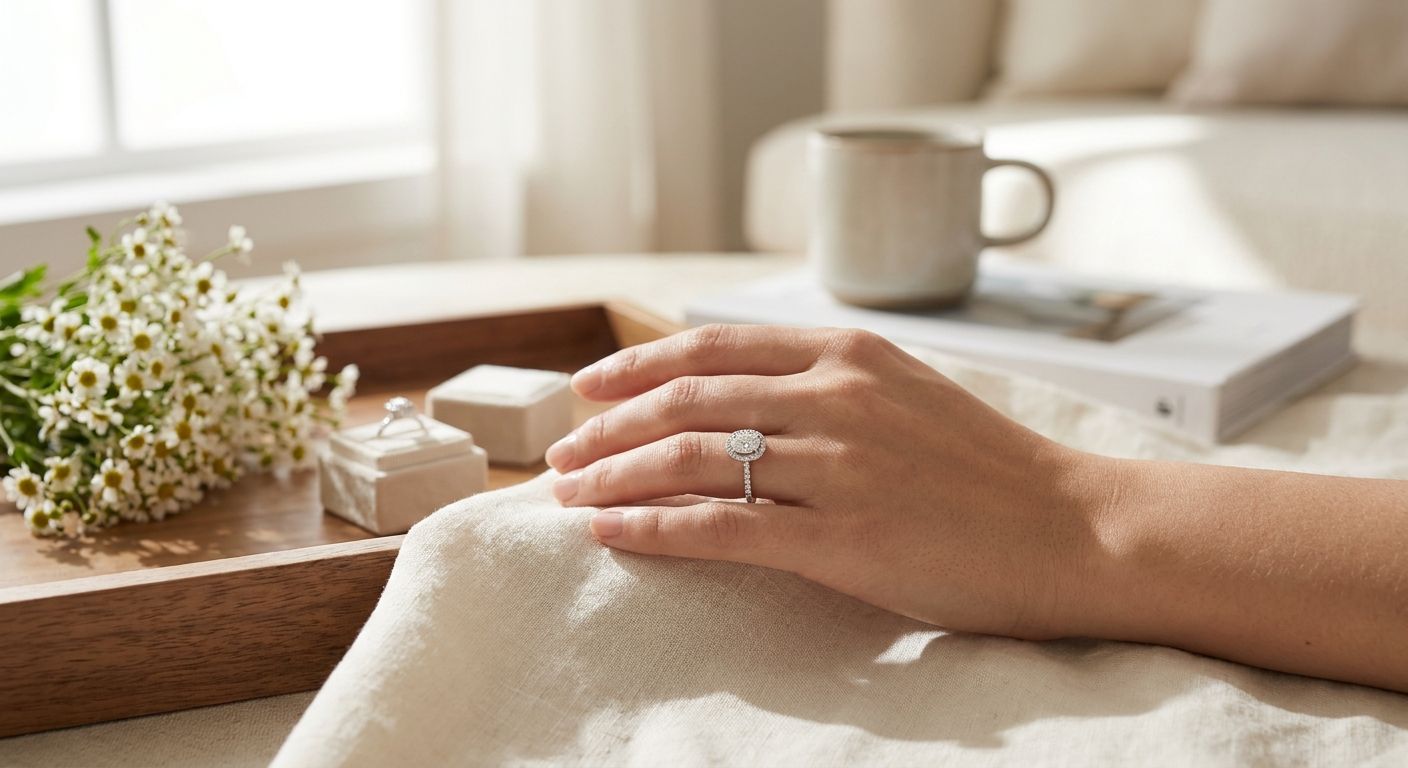
Halo engagement rings for petite hands work best when the halo shape elongates the finger instead of overwhelming it. Best overall: the oval halo — it stretches the finger visually and suits almost every petite hand shape. Best for finger coverage: the cushion halo — its rounded-square outline sits low and covers more knuckle-to-tip space without looking bulky. Best budget option: the classic round halo — a smaller center stone ringed in pavé reads bigger than its actual carat weight, so you spend less on the center stone and still get visual size.
- Oval halo wins for petite hands overall — it elongates the finger better than any other shape in 2026.
- Cushion halo is the pick for shorter fingers needing more visual coverage.
- Round halo classic is the budget move: smaller center stone, same perceived size.
- Emerald-cut halo suits slender-finger illusion and everyday office wear.
- Lab-grown diamond engagement rings from Raul Diamonds run IGI/GIA certified across every halo shape here.
Why this matters
A halo setting exists to do one job: make a center stone look larger than its carat weight suggests. On a petite hand, the wrong halo shape can make fingers look shorter or the ring look top-heavy. Raul Diamonds builds each halo engagement ring made-to-order with certified lab-grown diamonds, which means the shape and setting decision matters more than chasing carat weight alone — you're not locked into whatever a jeweler already cut. Before comparing halo shapes, it helps to see the full range of lab-grown diamond engagement rings available in 2026, since halo is one setting style among several worth weighing against a solitaire or three-stone build.
What makes the best halo engagement ring for small hands
- Elongating outline — oval, pear, and marquise-based halos stretch the visual line of the finger.
- Proportional halo width — a halo more than 1.5mm wider than the center stone starts to swallow a petite finger.
- Low profile setting — prong height that keeps the ring from catching on gloves or snagging fabric.
- Certified center stone — IGI or GIA paperwork on the lab-grown diamond, not just the halo pavé.
- Band width matched to finger size — a thinner band (1.5mm-1.8mm) reads better on petite hands than a 2.5mm+ band.
- Total carat weight (TCW) clarity — knowing what portion is center stone versus halo accent stones.
Halo engagement rings for small hands at a glance
| Style | Best for | Standout feature | Key limitation |
|---|---|---|---|
| Oval halo | Petite hands overall | Elongates finger length | Needs even prong alignment to avoid a lopsided look |
| Cushion halo | Shorter fingers, more coverage | Rounded corners soften a small hand | Can look boxy if the halo is too thick |
| Round halo (classic) | Budget-conscious buyers | Smaller center stone reads larger | Least elongating shape of the group |
| Emerald-cut halo | Slender-finger illusion, daily wear | Long lines suit narrow fingers | Center stone inclusions show more easily |
| Pear halo | Accentuating short fingers | Teardrop point draws the eye upward | Point needs a protective prong on the tip |
| Double halo | Extra sparkle without bigger carat | Two rows of pavé add width and light | Adds visual weight if hands are very small |
How we ranked
Each style is ranked against the six criteria above, weighted toward elongation and proportional halo width since those two factors matter most on a petite hand — not against price or brand popularity.
1. Oval halo: best halo engagement ring for petite hands overall
An oval center stone surrounded by a rounded halo is the most consistently flattering choice across different petite hand shapes, because the elongated silhouette does the visual work regardless of finger length.
Oval halo pros:
- Elongates the finger more than any round-based shape
- Reads larger than its actual carat weight due to the surface area of an oval cut
- Works with both vintage and modern band styles
Oval halo cons:
- Bow-tie effect (a shadow across the stone's width) can appear on poorly cut ovals
- Needs a well-matched halo width or the elongation effect weakens
Oval halo pricing: center stone carat weight drives most of the cost; a lab-grown oval typically prices lower per carat than a mined equivalent of the same clarity and color.
Best for: buyers who want one shape that works across most petite hand types. Verdict: Buy.
2. Cushion halo: best for shorter fingers needing coverage
The cushion cut's rounded-square outline sits lower on the finger than a pointed shape, which gives shorter fingers more visual coverage without adding height.
Cushion halo pros:
- Softens sharp angles, which suits rounder or shorter finger shapes
- Vintage-leaning silhouette pairs well with milgrain or filigree bands
- Halo pavé hides small inclusions in the center stone effectively
Cushion halo cons:
- Can look boxy if the halo width exceeds the center stone's proportions
- Less elongating than oval or pear shapes
Cushion halo pricing: cushion-cut lab-grown diamonds often price close to round cuts per carat, making this a reasonable middle option.
Best for: petite hands with shorter fingers who want more visible ring surface. Verdict: Buy.
3. Round halo (classic): best budget halo engagement ring for small hands
A round center stone in a tight halo setting is the most efficient way to get visual size without paying for extra carat weight, since the pavé ring does the size-perception work.
Round halo pros:
- Most widely available shape, so more setting and band combinations exist
- Smaller center stones (0.50ct-0.70ct) still look substantial inside a halo
- Classic look ages well and resells easier if that ever matters
Round halo cons:
- Least elongating shape on a petite hand
- Round cuts price highest per carat among common cuts, so budget savings come from going smaller, not from the cut itself
Round halo pricing: the lab-grown diamond engagement ring cost guide puts the 2026 average at $2,800, with a $1,200-$6,000 range depending on carat and setting — a halo around a smaller round center stone tends to land toward the lower end of that range.
Best for: buyers prioritizing visual size per dollar over an elongated silhouette. Verdict: Buy.
4. Emerald-cut halo: best for slender-finger illusion and daily wear
The emerald cut's long, rectangular lines create a slimming effect on the finger itself, not just the stone, which is why it works well for daily wear on petite hands.
Emerald-cut halo pros:
- Long lines make fingers look narrower and longer at the same time
- Step-cut facets show a different kind of sparkle than brilliant cuts — fewer flashes, more flat light
- Low profile settings are common with this cut, reducing snag risk
Emerald-cut halo cons:
- Inclusions and color are harder to hide in a step cut, so clarity grade matters more
- Fewer facets mean less overall fire compared to round or oval
Emerald-cut halo pricing: check the emerald-cut lab-grown diamond engagement ring guide for clarity grade recommendations before choosing carat weight, since this cut shows flaws more readily than brilliant cuts.
Best for: petite hands wanting a slimming effect for everyday wear. Verdict: Buy.
5. Pear halo: best for accentuating short fingers
A pear-shaped center stone with a matching halo draws the eye upward toward the point, which lengthens the visual line of a short finger more aggressively than a rounded shape.
Pear halo pros:
- Strongest elongation effect among common halo shapes
- Distinctive silhouette that stands out from round and oval options
- Works well set with the point toward the fingertip for maximum stretch
Pear halo cons:
- The point needs a V-prong or protective setting or it chips over time
- Orientation matters — set backward and the elongating effect disappears
Pear halo pricing: pear cuts often price slightly lower per carat than round cuts of comparable quality, since the elongated shape uses rough diamond material efficiently.
Best for: buyers who want the most dramatic elongation effect available. Verdict: Buy.
6. Double halo: best for extra sparkle without more carat weight
Two stacked rows of pavé around the center stone add width and light without increasing the center stone's actual size, which appeals to petite hands wanting more presence from a smaller diamond.
Double halo pros:
- Adds noticeably more sparkle and perceived size than a single halo
- Works well with smaller center stones (under 1.0ct) that need more visual weight
- Pairs well with a plain, thin band to balance the extra halo width
Double halo cons:
- Can overwhelm a very small hand if the halo width isn't kept tight
- More pavé stones mean more prongs, which adds long-term maintenance
Double halo pricing: the extra row of accent diamonds adds modestly to setting cost versus a single halo, though the center stone still drives most of the total.
Best for: petite hands wanting maximum sparkle from a modest center stone. Verdict: Hold — try it on before buying if your hand is very small.
Which halo engagement ring should you choose?
If you're undecided, default to the oval halo — it's the most broadly flattering shape for petite hands and works with nearly any band style. Choose cushion if your fingers are shorter and you want more surface coverage, choose emerald-cut if you want a slimming daily-wear look, and choose round halo if the budget needs to stay closer to the lower end of the 2026 $1,200-$6,000 range.
“The halo shape does more for how a ring looks on a small hand than the center stone's actual carat weight ever will.”
FAQ
What is the best halo engagement ring for small hands?
The oval halo is the best overall choice for small hands because its elongated shape stretches the visual line of the finger. Cushion and pear halos are close alternatives depending on finger length and desired sparkle.
Does a halo setting make a diamond look bigger?
Yes, a halo setting surrounds the center stone with small pavé diamonds to increase its perceived size without adding carat weight. This is why round halos are a common budget move for smaller center stones.
Is oval or round better for petite hands?
Oval is generally better for petite hands because it elongates the finger, while round is the more budget-efficient choice since it reads larger relative to its actual carat weight inside a tight halo.
How much does a halo engagement ring cost in 2026?
Lab-grown diamond engagement rings average $2,800 in 2026, with a typical range of $1,200 to $6,000 depending on carat weight, cut, and setting style, according to the Raul Diamonds cost guide.
What band width works best with a halo ring on a small hand?
A band between 1.5mm and 1.8mm generally suits petite hands better than wider bands, since it keeps the halo as the visual focus instead of competing with a thick shank.
Are lab-grown diamonds a good choice for a halo ring?
Lab-grown diamonds carry the same IGI or GIA certification standards as mined stones and typically cost less per carat, which lets buyers choose a larger center stone or a more elaborate halo for the same budget.
Does a double halo work on a small hand?
A double halo can work on a small hand if the total halo width stays tight against the center stone, but a very small hand risks the extra pavé rows looking oversized. Trying it on before buying is the safer move.
One last thing
Ask for the total carat weight (TCW) broken out separately from the center stone's carat weight before you buy — halo pavé adds visual size but doesn't count toward the center stone grade on your certification paperwork, and buyers who skip this step are often surprised later that their "1.5ct-looking" ring has a 0.80ct certified center stone.