Princess cut engagement rings deliver the most brilliance per dollar of any square-shaped diamond, and picking the right setting matters more than picking the right vendor. The classic solitaire princess cut wins for most first-time buyers, the princess cut halo wins for anyone chasing maximum perceived size, and the three-stone princess cut wins for couples who want built-in symbolism. Everything below breaks down which setting fits which priority so you don't end up with a ring that looks great on Instagram and wrong on your hand.
- Classic solitaire princess cut engagement rings from Raul Diamonds win for buyers who want a timeless, low-maintenance shape.
- Princess cut halo settings add roughly 10-15% more visible sparkle without upgrading carat weight.
- Three-stone princess cut rings cost more upfront but carry the strongest symbolic meaning.
- IGI or GIA certification matters more on princess cut than round cut because corner symmetry is easy to fake in photos.
- Lab-grown diamond engagement rings average $2,800 in 2026, with a $1,200-$6,000 range depending on carat and setting.
Why this matters
Princess cut diamonds have four sharp corners, and those corners are the single biggest risk factor in the shape. A round brilliant has no vulnerable edges; a princess cut chips if the prongs don't cover the points. That's why the setting you choose matters as much as the diamond grade itself, and it's why this list ranks settings, not just stones.
Most buyers land here after already reading a general lab-grown diamond engagement rings guide and narrowing down to princess cut specifically. Good instinct — princess cut is the second most-requested shape after round for a reason: it looks larger than its carat weight suggests and it costs less than round for the same size, because more of the rough diamond survives the cutting process.
In 2026, certification isn't optional. Every princess cut ring on this list should ship with IGI or GIA paperwork confirming cut symmetry, since a poorly cut princess stone loses fire fast and no photo will show you that before you buy.
What makes the best princess cut engagement ring
- Corner protection — V-prongs or protective metal at all four points, non-negotiable on this shape
- Cut symmetry grade — princess cut hides poor proportions more easily than round, so the cert matters
- Color and clarity matched to brilliance — princess cut shows color faster than round at the same grade, so G or higher is the practical floor
- Band metal purity — 14K gold or platinum settings hold prong tension better over daily wear than lower-karat alternatives
- Carat-to-face-up ratio — princess cut reads larger than its carat weight, which changes how much size you actually need
- Certification body — IGI and GIA are the two labs worth trusting for lab-grown stones in 2026
Princess cut engagement rings at a glance
| Setting | Best for | Standout feature | Key limitation |
|---|---|---|---|
| Classic Solitaire Princess Cut | Minimalist buyers | Shows off cut and clarity with nothing competing for attention | Corners rely entirely on prong quality |
| Princess Cut Halo | Maximizing perceived size | Small accent stones add 10-15% more visible sparkle | Halo can chip more easily if the band gets knocked |
| Three-Stone Princess Cut | Symbolic meaning | Side stones represent past, present, future | Higher total diamond cost for the same center stone |
| Princess Cut Pavé Band | Extra shine without bulk | Diamonds set into the band add continuous sparkle | Pavé stones need more frequent prong checks |
| Vintage-Inspired Princess Cut | Antique-style brides | Milgrain edging and cathedral shoulders add detail | Detailed metalwork costs more to resize later |
1. Classic Solitaire Princess Cut: best princess cut engagement ring for minimalist style
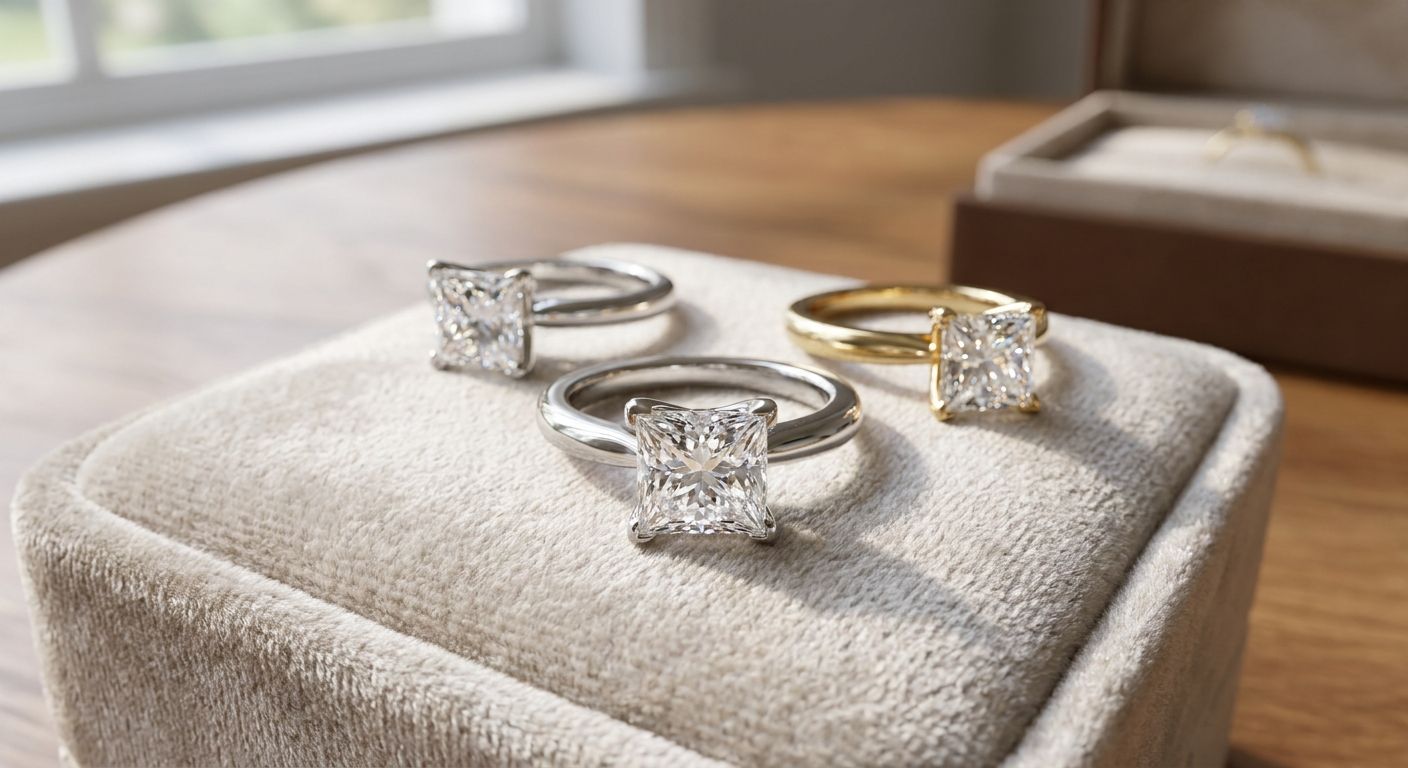
A solitaire puts one princess cut stone on a plain band with four V-prongs covering the corners. It's the shape's original setting and still the most requested, because nothing about the design competes with the diamond itself. Raul Diamonds builds these made-to-order, so the center stone carat, color, and clarity are chosen before the ring is cast.
Classic Solitaire Princess Cut pros:
- Cheapest way to get the largest visible diamond for the budget
- Easiest to resize and clean since there are no accent stones
- Corner protection is straightforward to verify at purchase
Classic Solitaire Princess Cut cons:
- No accent sparkle, so a lower-clarity stone shows more visibly
- Looks plain to buyers who specifically want a statement design
Best for: first-time buyers who want the diamond to be the whole story.
Verdict: Buy.
2. Princess Cut Halo: best princess cut engagement ring for maximizing perceived size
A halo surrounds the center princess cut stone with a ring of smaller diamonds, which pushes the total visible sparkle up without increasing the center carat weight. This is the setting to pick when the budget caps carat size but the goal is still a big-looking ring.
Princess Cut Halo pros:
- Makes a smaller center stone look noticeably larger
- Adds brilliance from every angle, not just the top
- Popular enough in 2026 that resale and appraisal comps are easy to find
Princess Cut Halo cons:
- More metal and stones mean more maintenance checkups
- A poorly matched halo can make the center stone look smaller by contrast if color grades don't align
Best for: buyers stretching a mid-range budget to look like a bigger stone.
Verdict: Buy.
3. Three-Stone Princess Cut: best princess cut engagement ring for symbolic meaning
Three matched or graduated princess cut stones sit side by side, traditionally read as past, present, and future. It's the setting couples pick when the story behind the ring matters as much as the look.
Three-Stone Princess Cut pros:
- Built-in symbolism that doesn't need explaining
- Total diamond weight is spread across three stones, which can look larger than one solitaire of the same total carat
- Side stones balance the center visually even at lower clarity grades
Three-Stone Princess Cut cons:
- Three cut-graded stones cost more than one center stone of equivalent total weight
- Matching color and clarity across three princess cuts takes longer on a made-to-order build
Best for: couples who want the ring to carry meaning beyond the shape.
Verdict: Buy if the budget supports it; otherwise hold for the solitaire.
4. Princess Cut Pavé Band: best princess cut engagement ring for extra sparkle without a busy design
Small diamonds set flush into the band add sparkle along the ring's shoulders while keeping the center stone as the focal point. It's a middle ground between a plain solitaire and a full halo.
Princess Cut Pavé Band pros:
- Adds continuous sparkle without competing with the center stone
- Costs less than a halo for a similar sparkle boost
- Sits flatter on the hand than a raised halo design
Princess Cut Pavé Band cons:
- Pavé stones need periodic prong inspection since they're smaller and more numerous
- Resizing a pavé band is more involved than resizing a plain solitaire shank
Best for: buyers who want more shine but not a bigger visual footprint.
Verdict: Buy.
5. Vintage-Inspired Princess Cut: best princess cut engagement ring for antique-style brides
Milgrain edging, filigree detail, and cathedral shoulders give the princess cut an antique look while keeping the modern square shape. This is the smallest slice of buyers on this list, but it's a real category with real demand.
Vintage-Inspired Princess Cut pros:
- Combines a modern cut with an antique aesthetic
- Filigree and milgrain add detail that reads well in close-up photos
- Works well with yellow or rose gold for a warmer, older-world look
Vintage-Inspired Princess Cut cons:
- Detailed metalwork costs more to repair or resize than a plain band
- Not every jeweler can match the filigree pattern exactly if the ring ever needs rebuilding
Best for: buyers who specifically want an heirloom look, not a modern minimalist one.
Verdict: Buy if the vintage look is the priority; skip if low maintenance matters more.
How this list was ranked
Each setting was scored against the six criteria above: corner protection, cut symmetry, color/clarity fit, band metal, carat-to-face-up ratio, and certification standard. The order reflects how many buyers each setting realistically serves in 2026, not which one photographs best. The classic solitaire ranks first because it satisfies every criterion with the fewest tradeoffs, not because it's flashiest.
“On princess cut, the corners decide whether the ring survives daily wear, not the carat weight.”
Which princess cut engagement ring should you choose?
If you're undecided, start with the classic solitaire princess cut — it's the safest choice for corner durability, the easiest to budget for, and the easiest to resize later. Move to a halo if the carat budget feels tight and you want more visible size. Choose the three-stone only if the symbolism matters enough to justify the higher diamond cost, and reserve the vintage-inspired build for buyers who already know they want an antique look over a modern one.
Whatever setting you land on, check the lab-grown diamond engagement ring cost guide before finalizing carat weight — knowing the $1,200-$6,000 range in 2026 changes how much carat you can actually afford at a given clarity grade.
FAQ
What's the best princess cut engagement ring setting in 2026?
The classic solitaire princess cut is the best overall setting in 2026 because it protects the four corners with simple V-prongs and costs less than halo or three-stone alternatives. A halo setting is the better pick if the goal is maximizing perceived size on a fixed carat budget.
Is princess cut cheaper than round cut?
Yes, princess cut typically costs less than round cut for the same carat weight because the cutting process wastes less of the rough diamond. The savings usually show up most clearly above 1 carat.
Do princess cut diamonds chip easily?
Princess cut diamonds have four unprotected corners that can chip if the setting doesn't cover them properly. V-prong settings are designed specifically to protect these corners and are the standard choice for this shape.
How much does a princess cut lab-grown diamond ring cost in 2026?
Lab-grown diamond engagement rings average $2,800 in 2026, with a typical range of $1,200 to $6,000 depending on carat weight, setting style, and certification. Princess cut generally falls at the lower end of that range compared to round cut at the same carat.
Should I get IGI or GIA certification for a princess cut diamond?
Both IGI and GIA are reliable certification bodies for lab-grown princess cut diamonds in 2026. The certificate matters more on princess cut than round cut because cut symmetry is harder to judge by eye on a square shape.
Does a halo make a princess cut diamond look bigger?
Yes, a halo setting adds a ring of small diamonds around the center stone, which increases visible sparkle and makes the center princess cut appear larger without increasing its actual carat weight.
What carat princess cut looks best for an engagement ring?
Princess cut reads larger than its carat weight compared to round cut, so a 1-carat princess cut often looks close to a 1.1-1.2 carat round. Buyers on a budget can size down slightly and still get a similar visual footprint.
Is a three-stone princess cut ring worth the extra cost?
A three-stone princess cut costs more than a single solitaire of the same total carat weight because three cut-graded stones are priced individually. It's worth the extra cost mainly for the symbolic meaning, not for size or brilliance alone.
One last thing
Princess cut uses more of the original rough diamond during cutting than round brilliant does, which is the real reason it's priced lower per carat — not a quality shortcut, just less waste in the cutting room. That's worth knowing before assuming a lower price on a princess cut means a lower grade.